¡’Iorana! (Hello in Rapa Nui)
Visiting Easter Island has been on my bucket list for a very long time, and finally stepping foot on the tarmac of the tiny airport was truly a dream coming to life. To get there, you take a LATAM flight from Santiago, and it takes about 5 hours, and then you get to the tiny island of Rapa Nui, Isla de Pascua, or Easter Island. There is only 1 flight a day, so the airport terminal is a gate of 1. You walk down the steps from the side of the airplane, and you are there! I traveled with my friend Maria, and we had an awesome time! Upon arrival, all of the hotel and bnb hosts greet you with your name on a sign and a necklace of fresh flowers. (I don’t know if lei is Hawaiian… so I don’t know what to call it here.)
I learned so much about the history and the culture of the Rapa Nui people while I was there, and I will sprinkle that in throughout. I arrived knowing not a whole lot, and left feeling like a happy nerd.
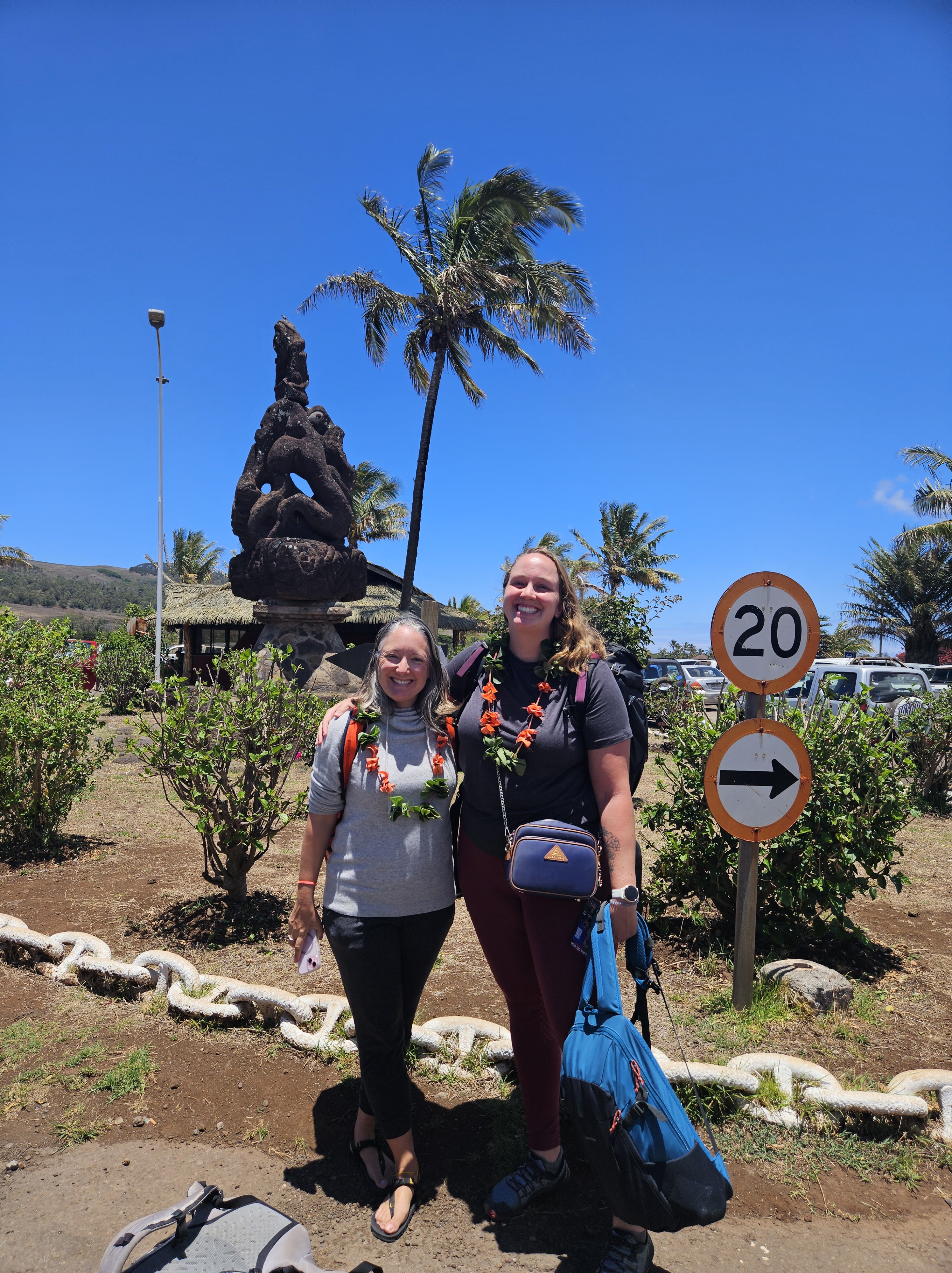
Our host picked us up and gave us a mini tour of Hanga Roa (the only city) to help us get oriented to our new home. She was so sweet, giving us restaurant recommendations, and she also helped us book all of our tours. In total, we were on Isla de Pascua for 5 days- 2 of them were kind of travel days because the flight was in the middle of the day. We did 2 full days of touring the moai and national park, and then had a third day for an activity of choice. I chose snorkeling and Maria went diving and then we did a cultural dance show. I think 5 days was perfect, but you could also do it all in 4.

After arriving and eating something, Maria and I sat by the natural pools and hung out and swam. These pools were super cool. The water was perfect, and the Pacific ocean is just like, there. There is a small ish wall to “enclose” the pools, but you can also catch some waves. We watched a dog chase after the waves for the entire time we were there, and it was the cutest and purest joy I’ve witnessed in a long time.
Then we spotted the sea turtles. They live right by the coast, and you can swim with them. Don’t touch them or feed them, but you can just stand there and they swim around you. All of this is free, just respect the nature. (More on turtles to come.)

The sunset spot is Tahai. This was my first view of the moai heads, and watching the sun go down was really neat. Depending on where you sit, the sun can disappear right between the moai.
Moai: (n)- the statues of the people that Easter Island is famous for. These are not built to worship gods, but they are statues of the ancestors of the chiefs of the village. Villages would decide if their chief deserved or earned a statue after they died. The statues are always facing inland with their backs to the sea because the statue is oriented towards the village. The statues were the ancestors watching over everyone. Originally, the statues had eyes made out of coral and obsidian, but many of those have been lost. The eyes would only be put in to “wake up” the statues when and if the statues made it to the platforms where they are standing. The majority of the moai never made it to the platforms because transporting them was a difficult task.
Okay- so we start the first day of our tour, and I am PUMPED to see some statues. We roll up to essentially a pile of rocks… which we learn is a bunch of moai that are face down. Once you are taught to pick out the shapes, you can see it. However, it was an underwhelming start.
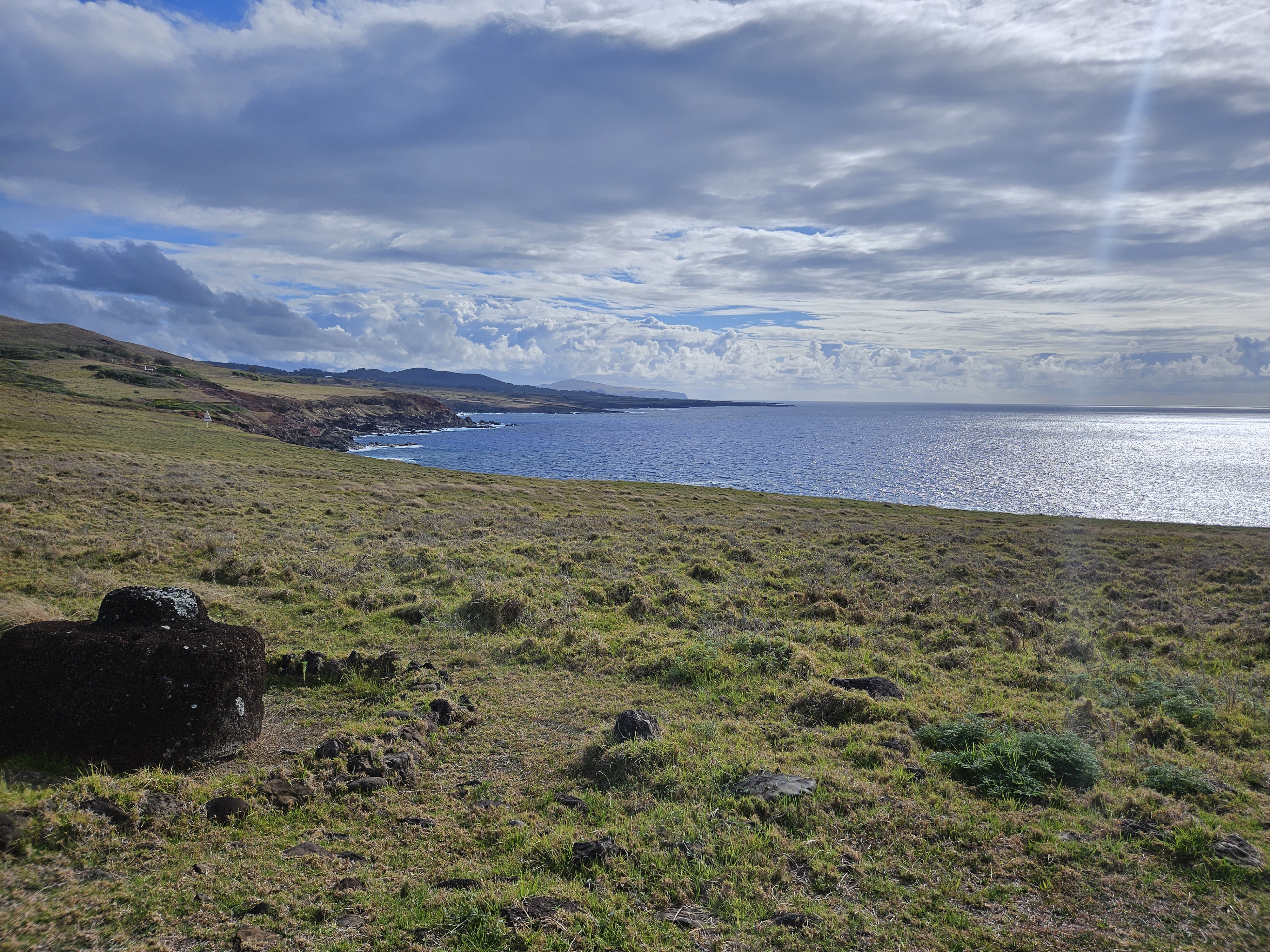

At this sight, we learned about the clan wars. The moai were toppled during a period of unrest between the clans of the island. The moai heads were the ancestors watching over the villages, right? There were over 10 clans (I think) spread out throughout the island, and idk how this started, but someone showed up and knocked over somebody’s statue and then it was game on. Until relatively recent history, all the moai were toppled. That is, until Japan donated a crane and people figured out how to raise the moai up without destroying them. Some of them are restored, but most are original. There is a debate about whether to restore them so that tourists can get a better idea of what it would have been like, but people on the other side of the debate think it is better to preserve what they have in order to not erase the history of the toppling and re-building, etc.
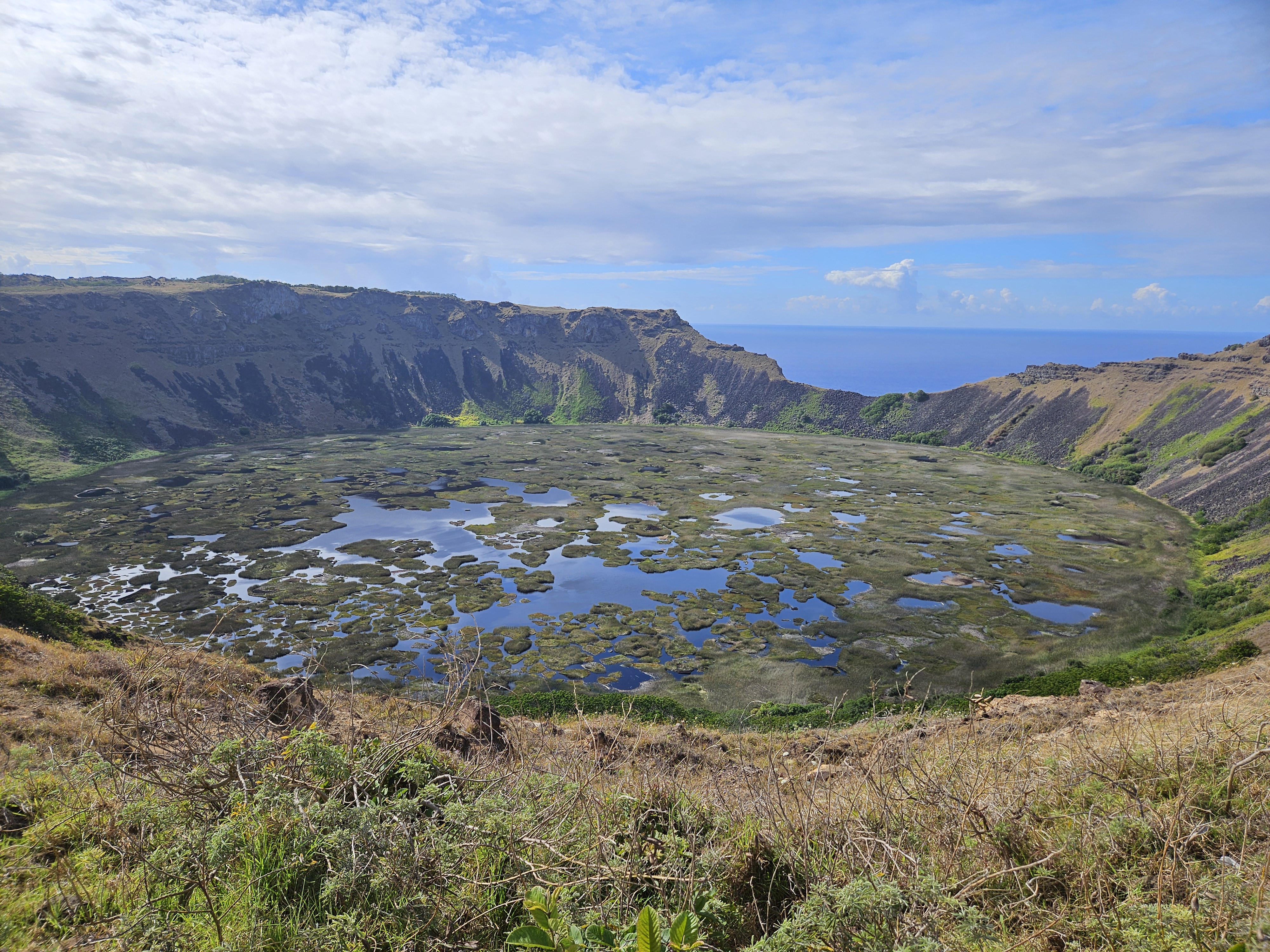


Next up was Rano Kau- the crater. It is absolutely gorgeous. The top is 1 mile diameter, and there are so many species of flora that are growing on the inside. This used to be used as farmland. You will also see a clear petroglyph of the birdman. This crater is the last stop on the way to Orongo, and this petroglyph was showing people that they were almost there.
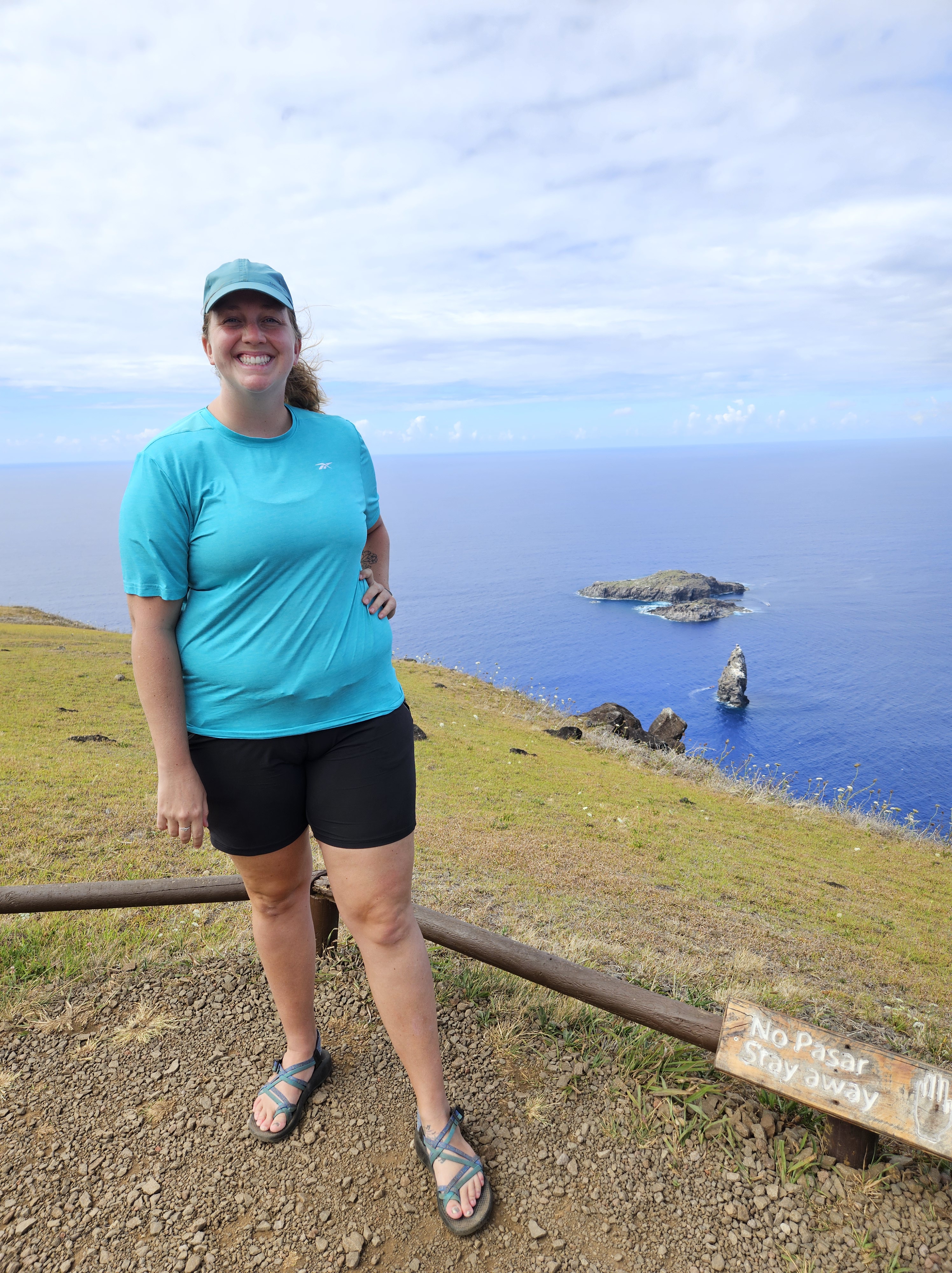
Orongo was the ceremonial village were the Birdman games took place. In this picture, I’m standing in front of the birdman islands. The story I’m going to attempt to tell you absolutely blew my mind. While of course seeing the moai was top notch, learning about this and seeing the birdman islands are possibly the highlight of my trip. I’m no historian, but let me tell you the story of the Birdman games in my own way.
After the clan wars, the clans were like guys we have to stop fighting, and they came up with a new way to pick a leader- the birdman games. The sooty tern birds would appear once a year and lay nests on this island, and this was a big deal for the Rapa Nui people. There were people who’s job it was to sit in a cave and wait for the birds. When they saw the birds they would then signal the clans that it was time.
Ten clans- each would select one warrior to be the champion for them to compete. They would race down a volcanic cliff (that I’m standing near) to get to the ocean in order to swim 1 mile to the furthest island where the birds make their nest. Then the warriors would climb up those volcanic cliffs to find the first egg of the season. They would stick the egg gently into a cloth headband and then start their way back. They swim back, climb back up the volcanic cliffs and present it to their chief.
(I asked what happened if the warriors found more than 1 egg, but our guide said that as soon as 1 was found, everyone stopped competing and the victor was able to take his time trying to make it back. So, no brawls.)
Guys- I looked at these cliffs. They are jagged and terrifying. One wrong step on the cliff = dead. The warriors wore only a loincloth and the headband. I personally have sensitive baby feet, I can’t imagine trying to walk, let alone sprint down the side of the cliff, on the volcanic rocks. Their feet would be bloody, and then they would enter the Pacific ocean. There are sharks in the Pacific ocean. Not necessarily aggressive sharks who live near Rapa Nui, but when sharks smell blood, they might realize they are hungry. Get eaten by a shark = dead.
Whoever wins the birdman games, their clan would rule for 1 year, until the birds came again the next year. These birdman games helped with corruption because the chances of winning the birdman games 2 years in a row was extremely low. Clan leaders ruled fairly because they didn’t want anyone to retaliate the next year when they weren’t in power anymore.
These birdman games went on until the mid 1850s until “explorers” came and the clans realized they needed to unite against the biggest threat of all -> colonizers.
I’m telling you- my mind was blown.
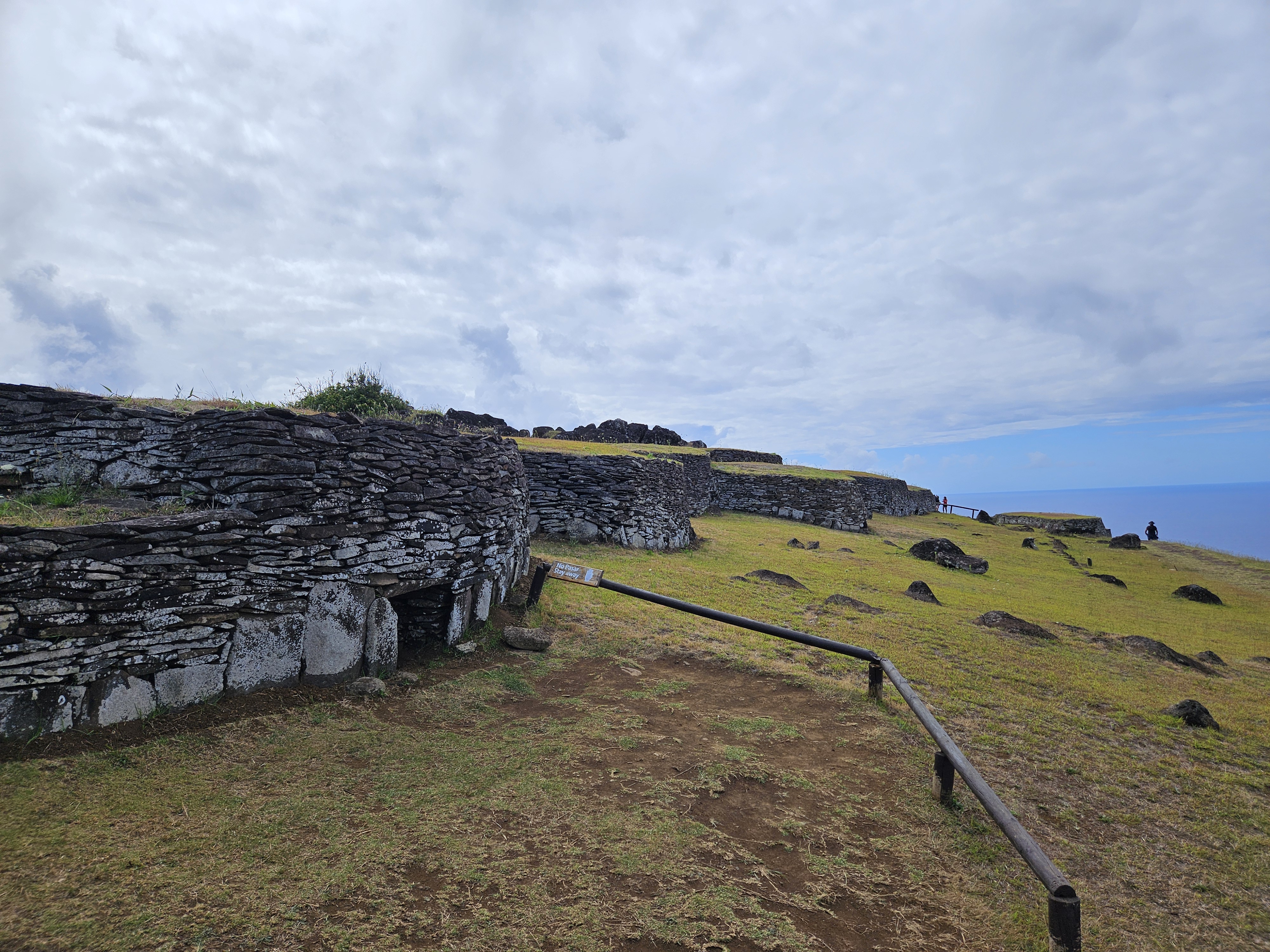
^ Little houses where the warriors and the chiefs would stay during the birdman games. They are still really in tact because of their positioning on the mountain, and they were only used once a year.
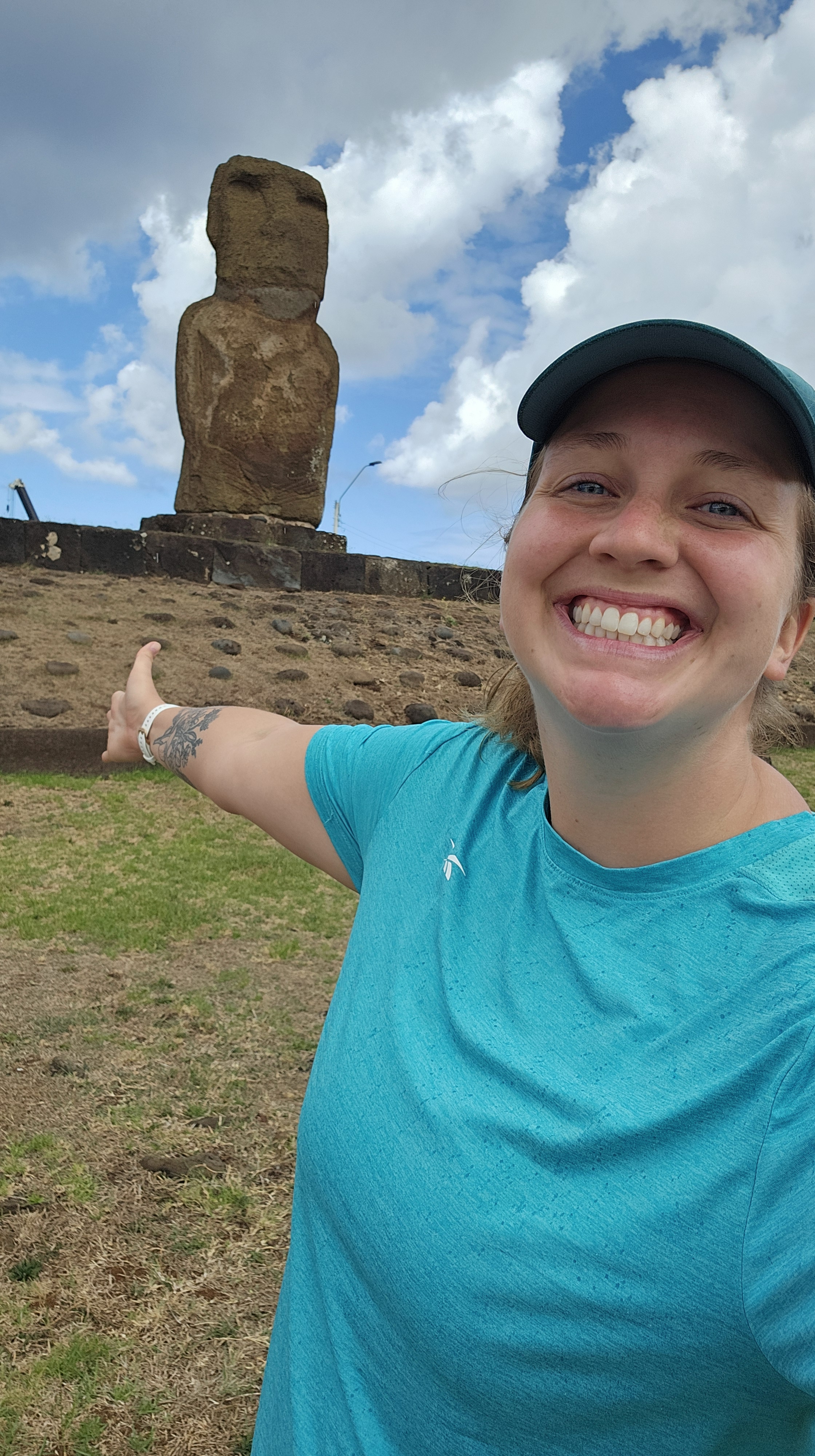
^ Last stop before lunch- Ana Kai Tangata. The first moai of the tour that was standing.
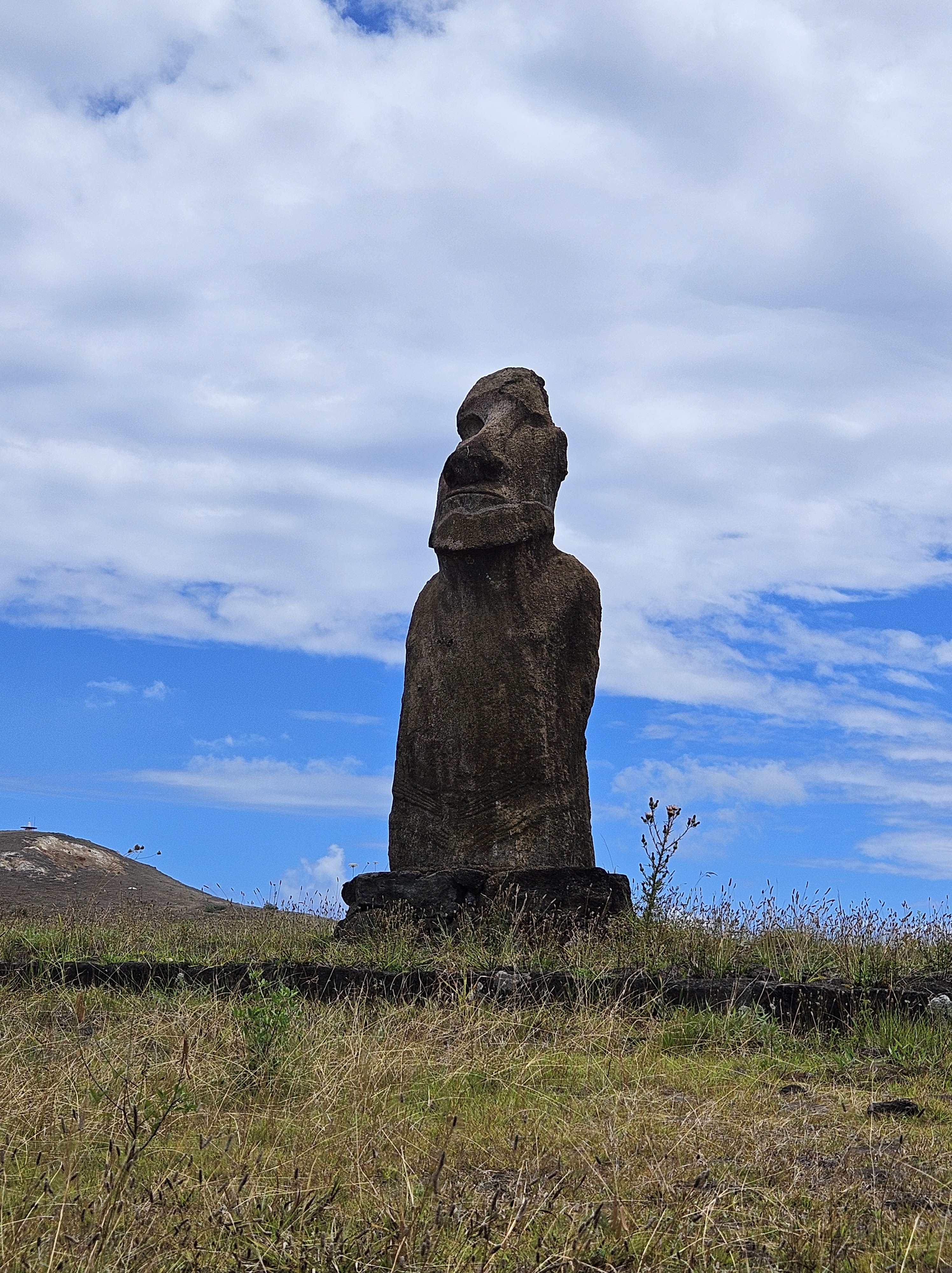
Starting off a little bit stronger after lunch, this is Huri A Urenga- a lonely moai in the middle of the field.


Nope, we weren’t being punked. This is Puna Pau- the quarry where the topknots were harvested. There was a little bit of an uphill, so at least the view was nice. These red volcanic rocks were used for the topknots of the moai.
I thought some of the moai were wearing hats. Apparently, this is incorrect, and they are representative of the hairstyle of the day- the topknot. Man buns have been cool for forever, guys. Also, these topknots were added after a moai statue had made it to the platform and been erected. Of course, every clan and leader wanted their moai to be bigger and better than those before. So the carvers were making them bigger, however, they couldn’t get them to the platforms. People got creative, and when they added these little hats/ topknots, it was able to add height in a second stage, and therefore more likely for all the pieces to make it to the platform.

My favorite from the first day- Ahu Akivi. This is 7 moai on a platform. This one is also in the middle of a field, but hey. The village couldn’t help where they were planted.


This will be true for all the pictures of the moai- the size really doesn’t show in the pictures. These guys are massive. And heavy. What’s that? You want some moai stats? Well, I’m glad you asked.
- Biggest: 21.6 meters, 160 tons
- Smallest erected: 1.13 meters
- Biggest erected: 9.8 meters, 74 tons
- Largest fallen during erection: 9.94 meters
- 887 registered moai
- 397 moai in the quarry
- 288 moai ereted on an ahu (platform)
- 92 moai en route to an ahu
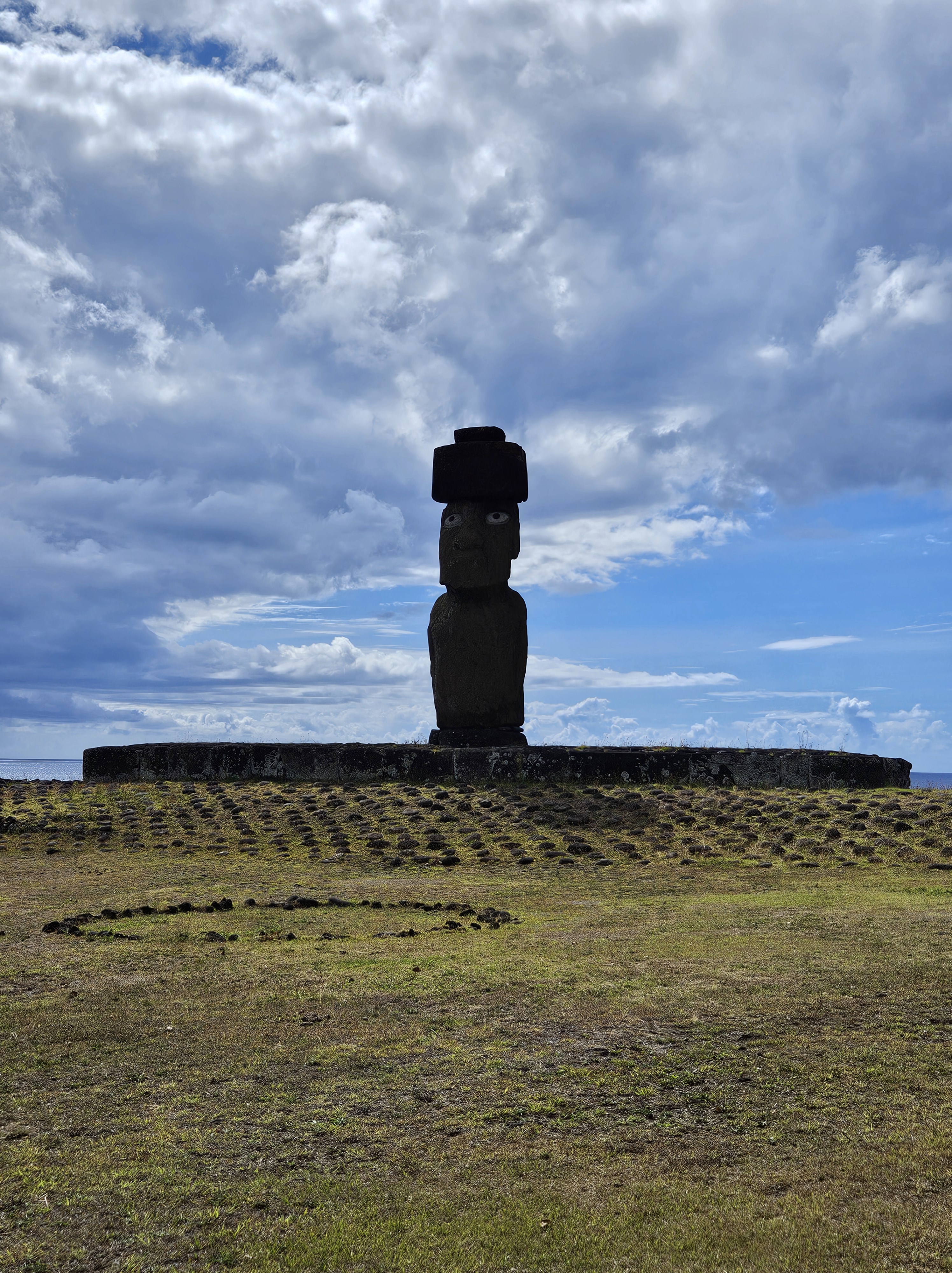

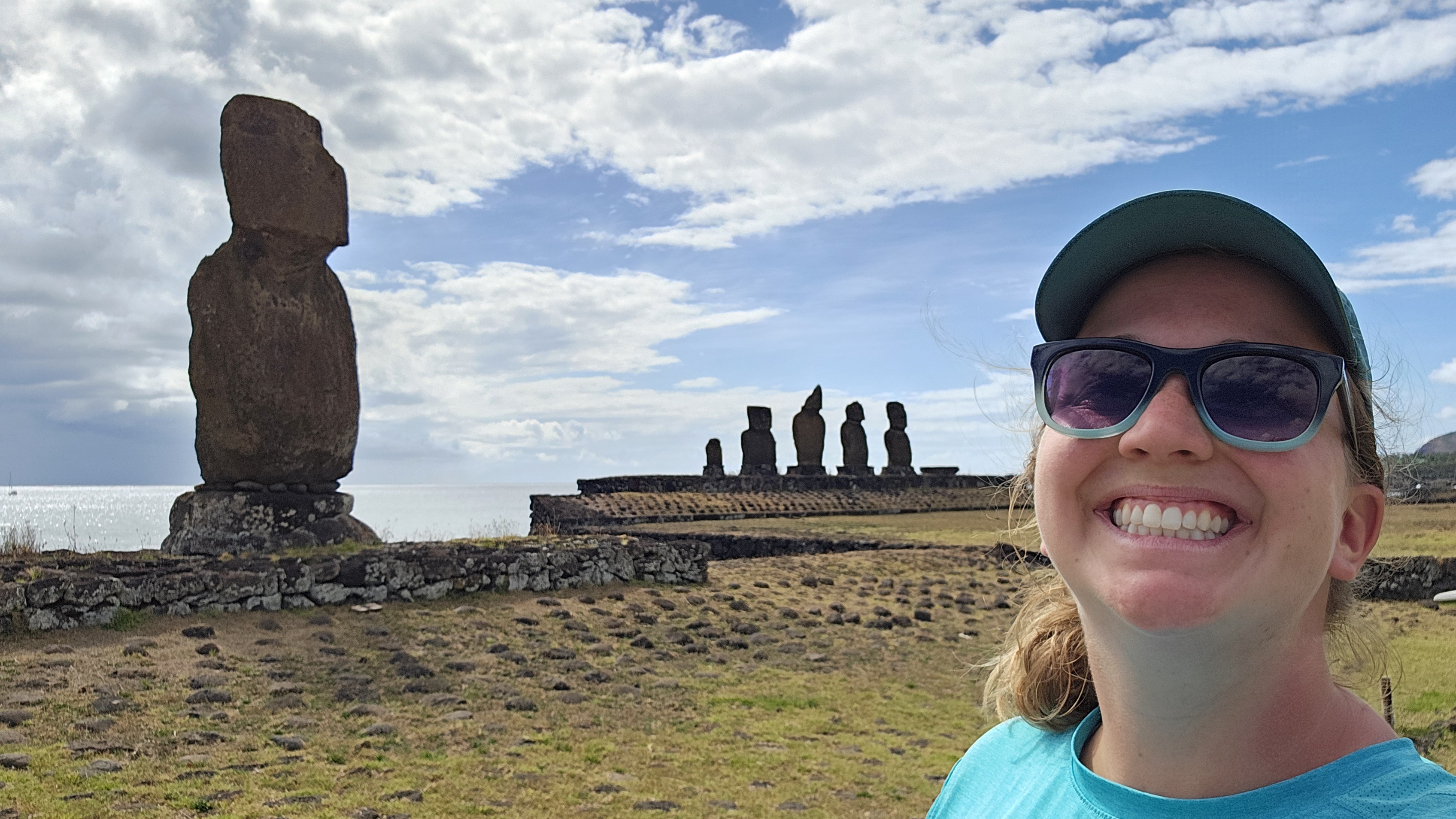
Our first tour day ended at Tahai (the sunset spot). Above you can see the recreation eyeballs, which I personally find very creepy. Tahai is a special spot because it has 3 different ahu’s (platforms), and it’s right by the ocean.
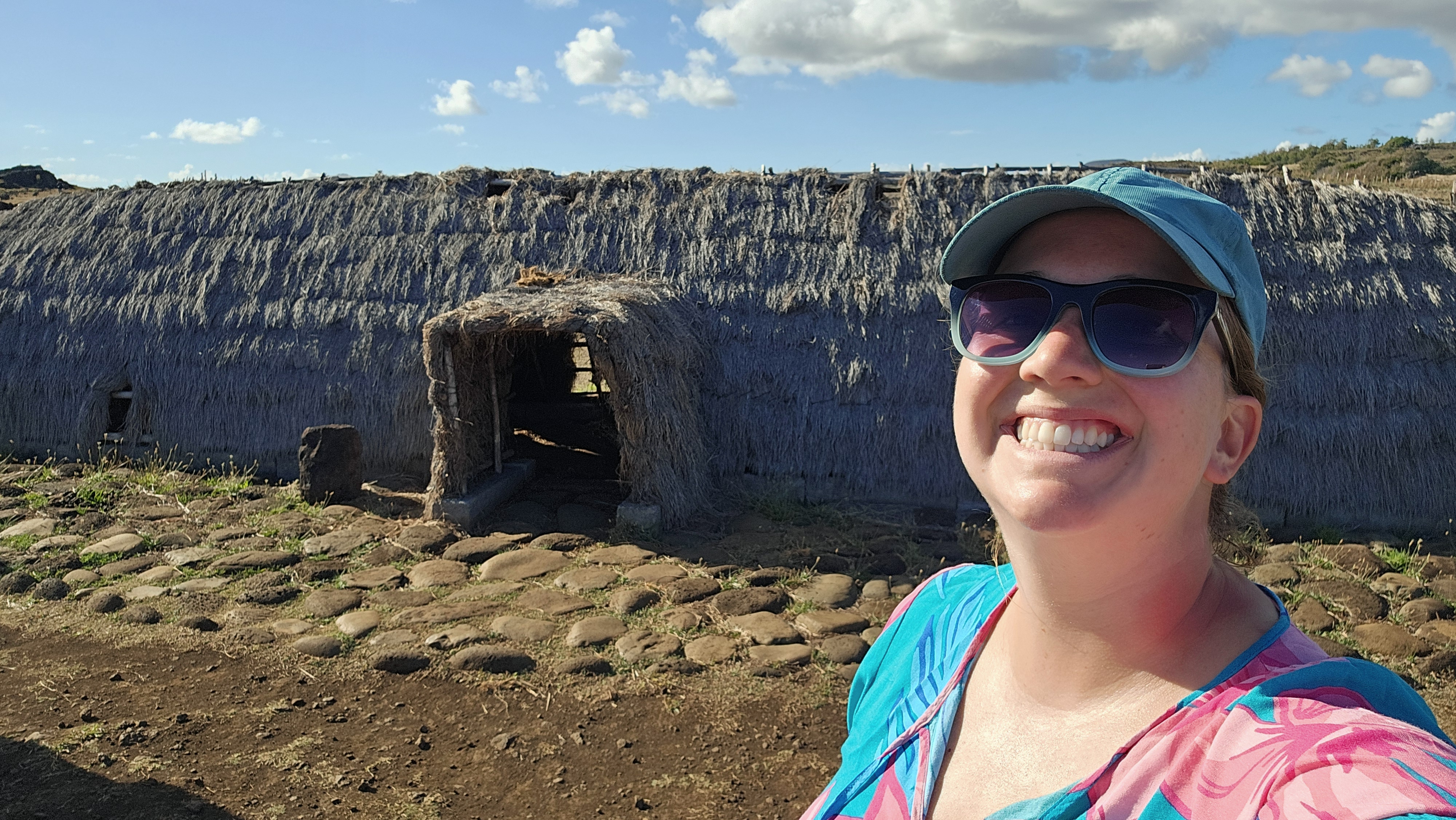
Tour day #2 starting strong with a visit to Vaihu. This site is all a recreation of the villages, which was very helpful for later on when we just saw a bunch of rocks. Easter Island is a fantastic case study of what happens with deforestation. When early islanders arrived, it was a beautiful forested area, and they used the trees to build all sorts of things. But they cut down the trees too fast too soon, and it effected the entire ecosystem. They couldn’t grow trees, and the rains shifted as well. They couldn’t collect rainwater, and they were surrounded by a saltwater ocean. The people got creative and started using the volcanic rocks as types of vertical farming.

The porous rocks could hold water, and if they planted things inside these little circle farms, they could grow crops. Desperation creates innovation, but I also think there is definitely a lesson to be learned in this. In many of my pictures, you’ll see just kind of blank land. The trees that you do see are young.

^ Being facedown, like this moai at Akahanga. This site is the real village, and we could see the layouts of the houses and village, but it is really just a picture of a field with rocks in it. In the above picture you can see one of the red topknots that had fallen.
The ahu’s (platforms) were always in front of a large space before any houses were built. The large space was used as community gathering spaces, and the house closest to the center was reserved for the head honcho.
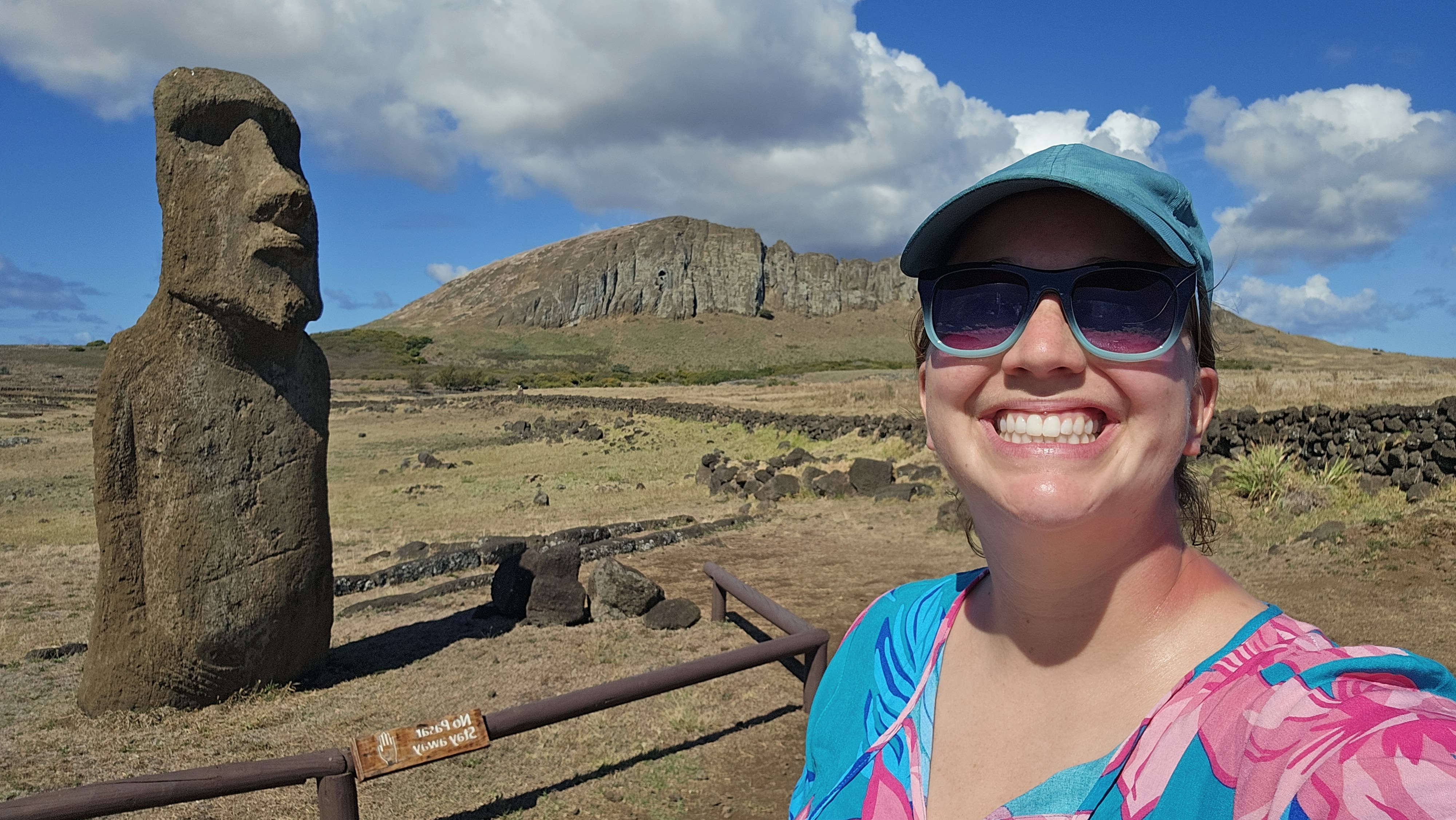


Welcome to Tongariki- what I thought of when I thought of Easter Island. This is the spot where there are 15 giant moai statues all in a row, right in front of the ocean. It was breathtaking an absolutely incredible. I’m sure it’s no coincidence that this location has the most moai because it is also the closest to the quarry.
The lonely top left moai is known as the “traveling moai.” In order to raise money from Japan to give them a crane, the Rapa Nui lent them a moai to travel around Japan. The Japanese people were enamored, and raised enough money to help the Rapa Nui people begin the process of righting the moai.
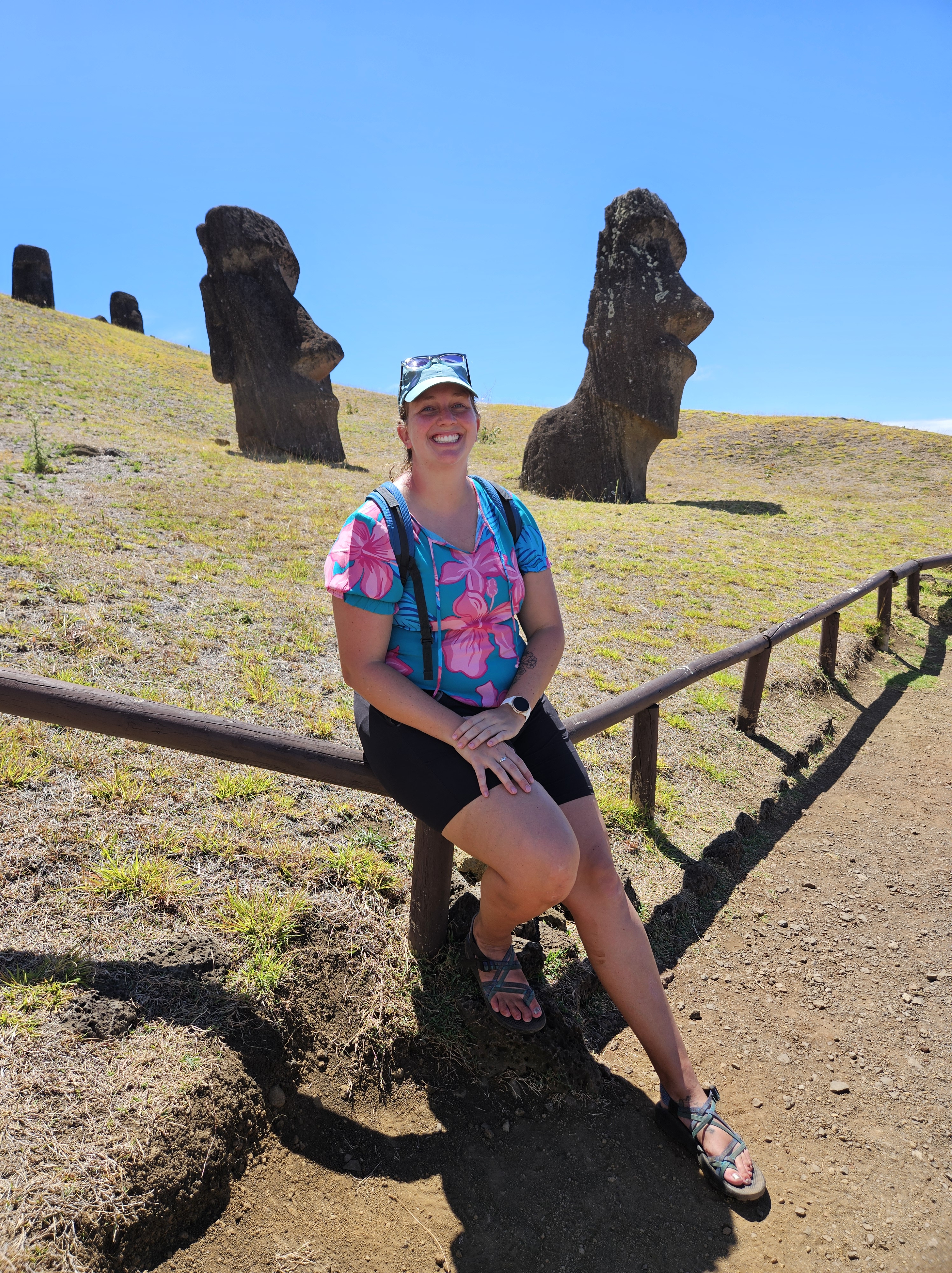
Next up is Rano Raraku- the quarry where the moai were carved. You walk among those that didn’t make it, almost like a moai graveyard, but less spooky.
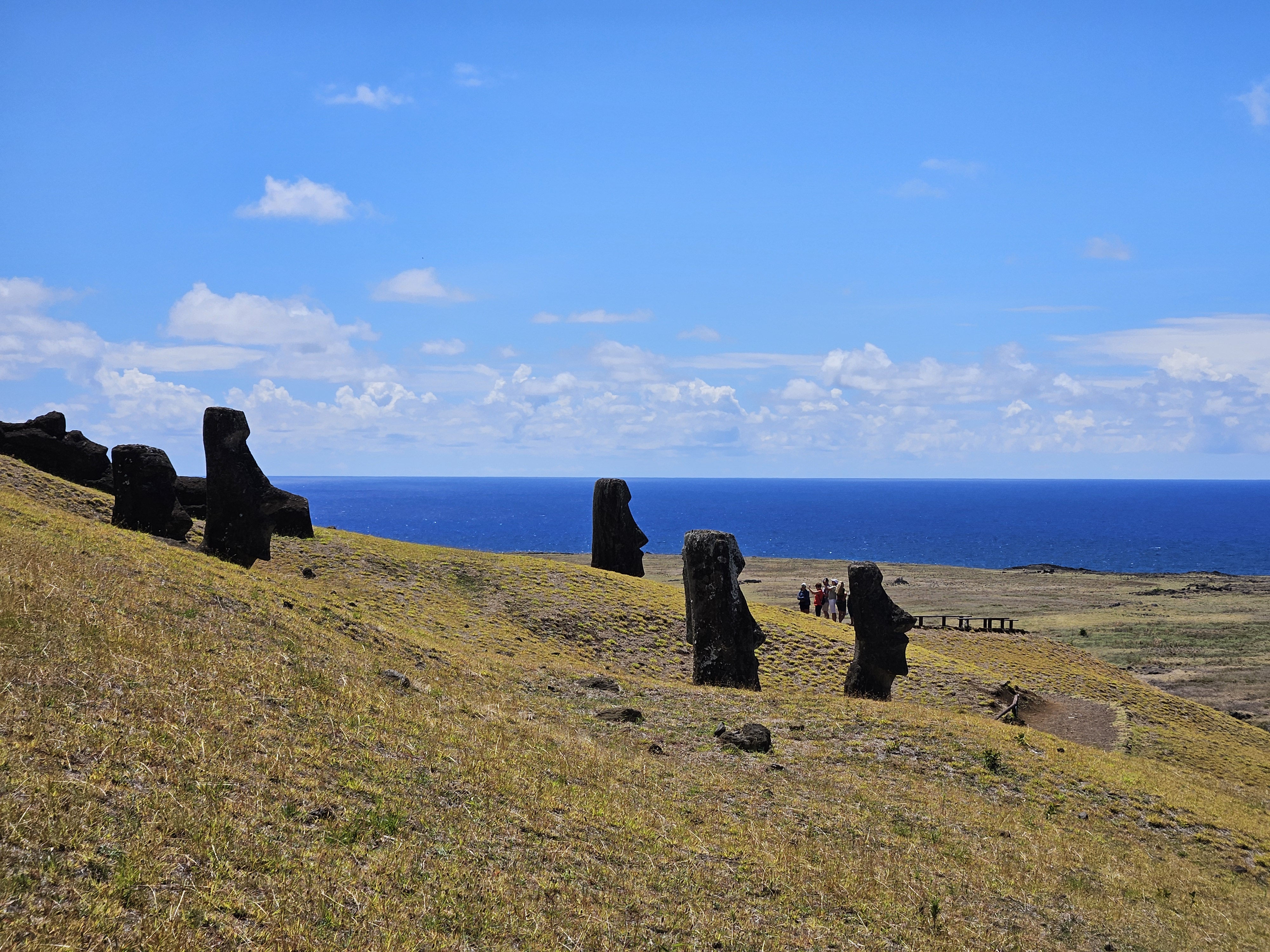

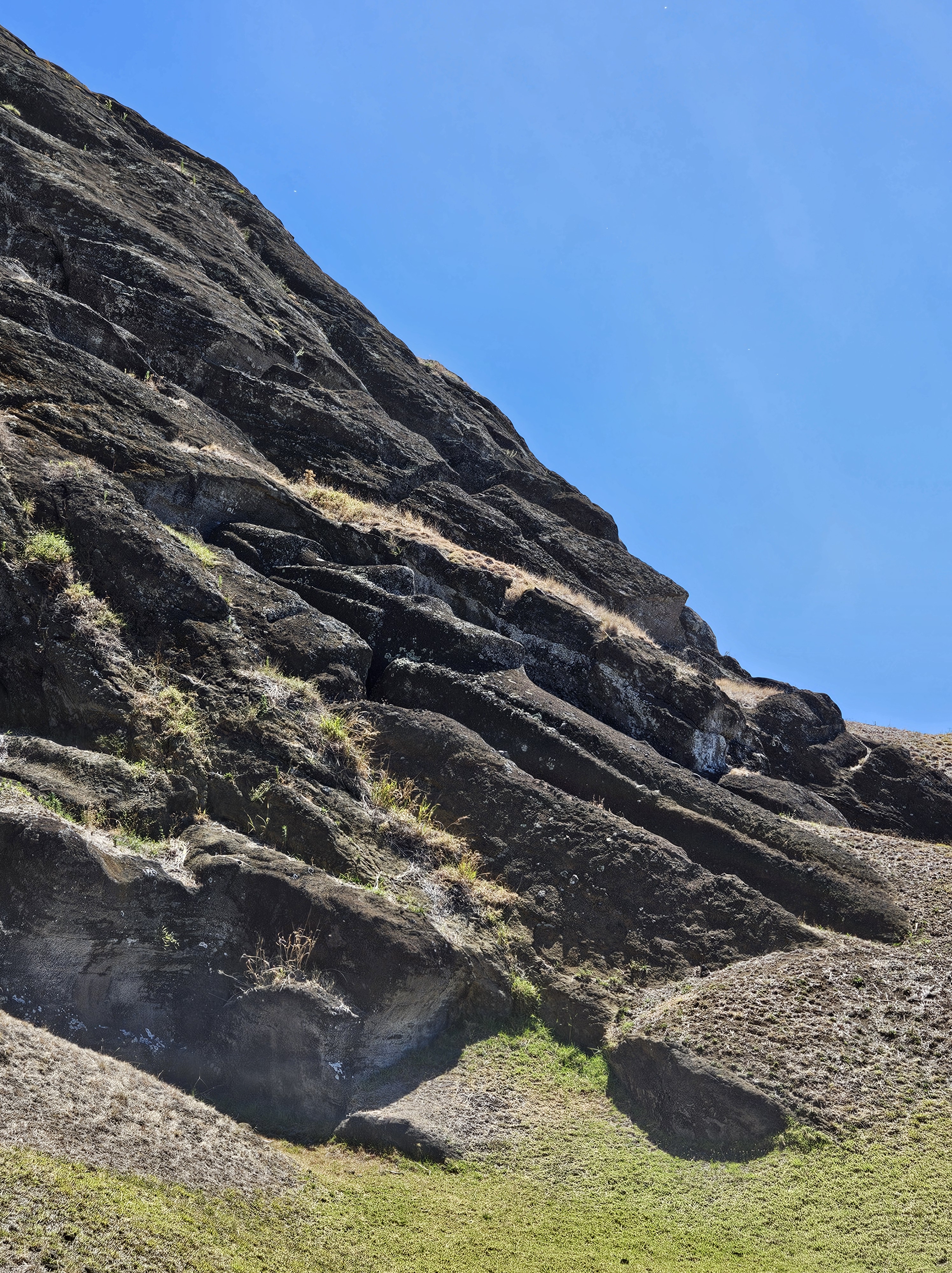
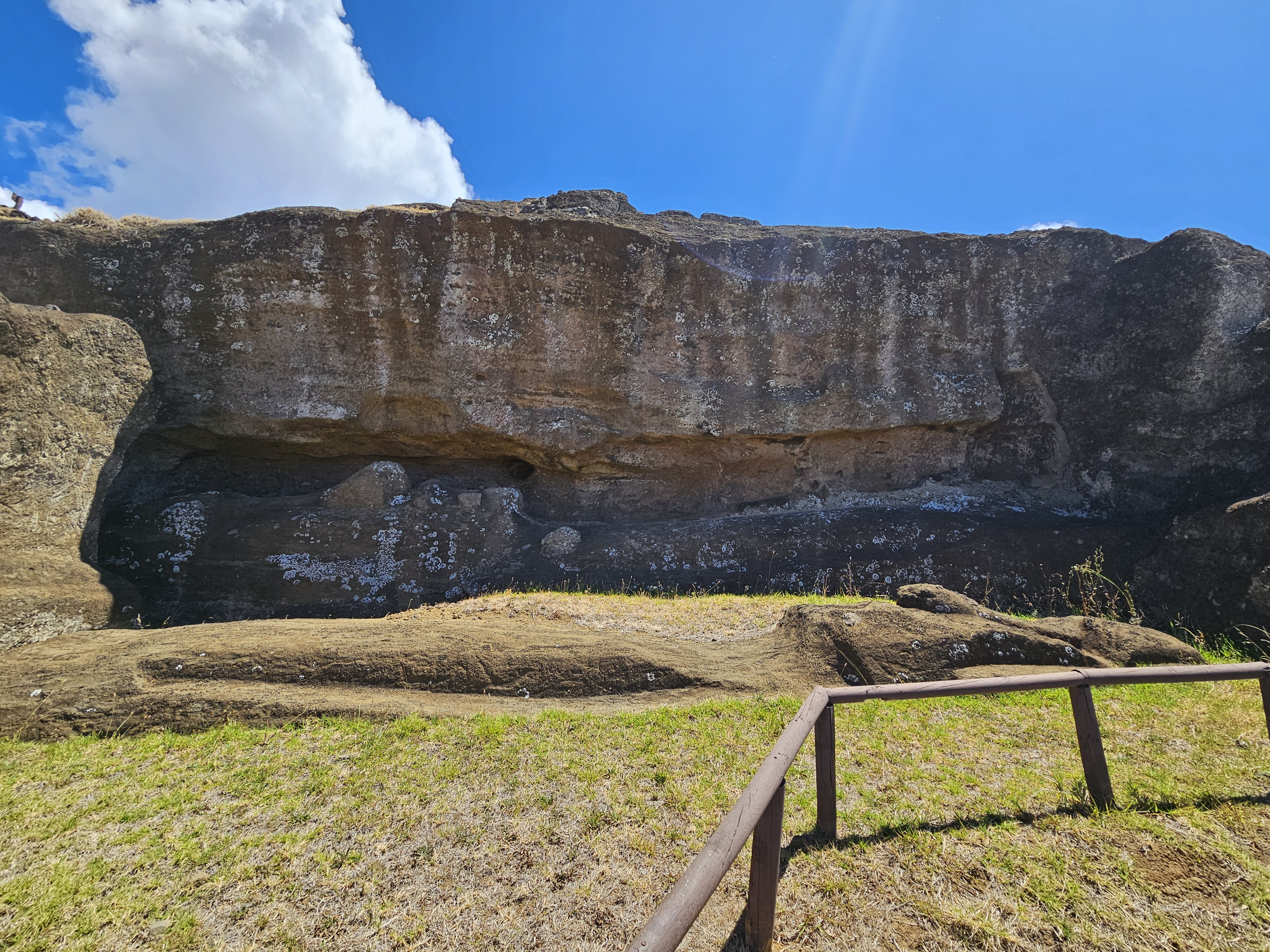


You can almost see the moai highway up there. In the picture that just looks like the side of a mountain, look closely- you will see the largest moai statue.
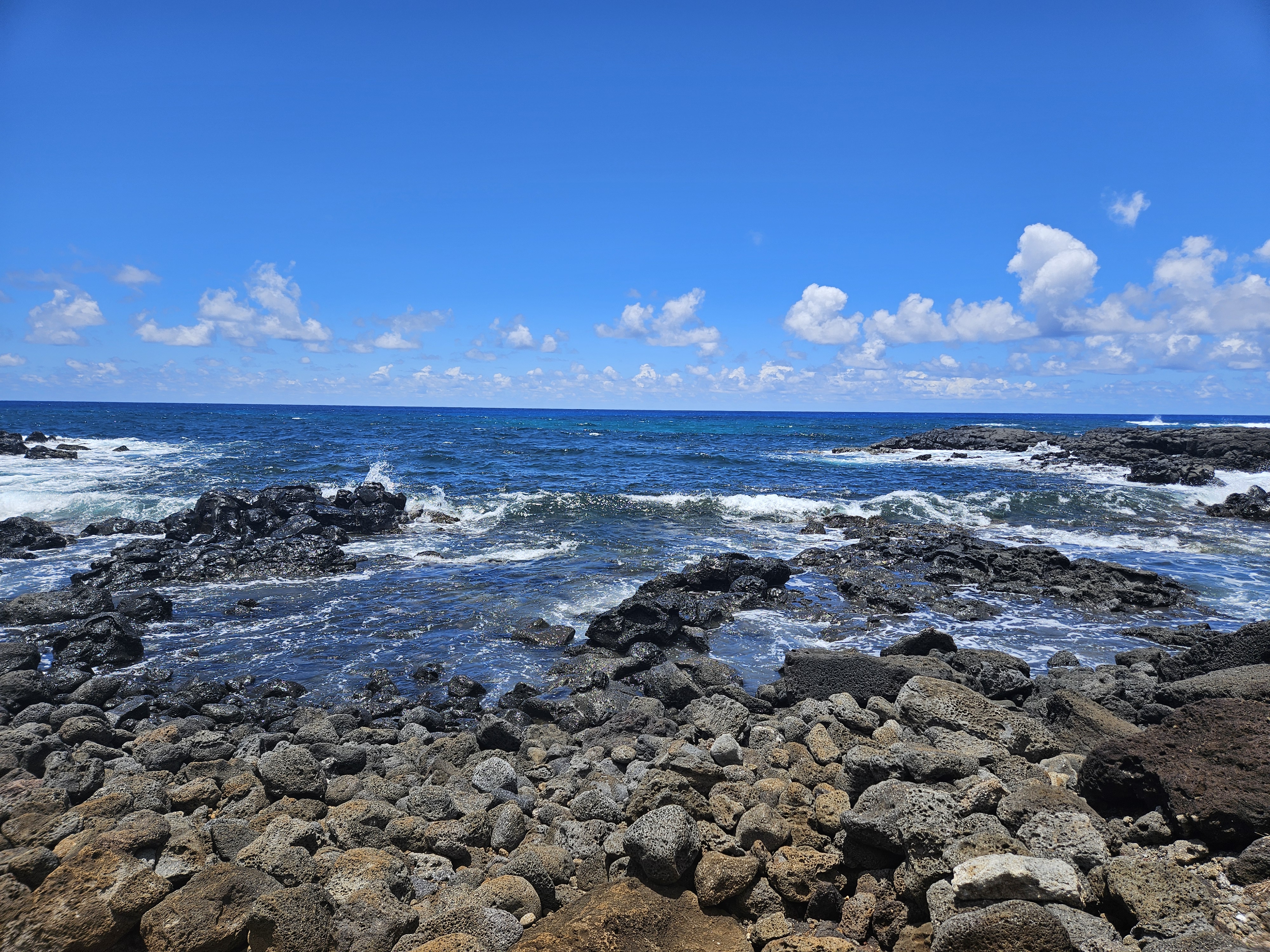
The sight they brought us to afterwards is called Te Pito Kura, and it was such a let down. It was 5 rocks that looked like a compass and are said to be magnetized, obviously by aliens. But it was lame, so here is a picture of the beautiful coast instead.

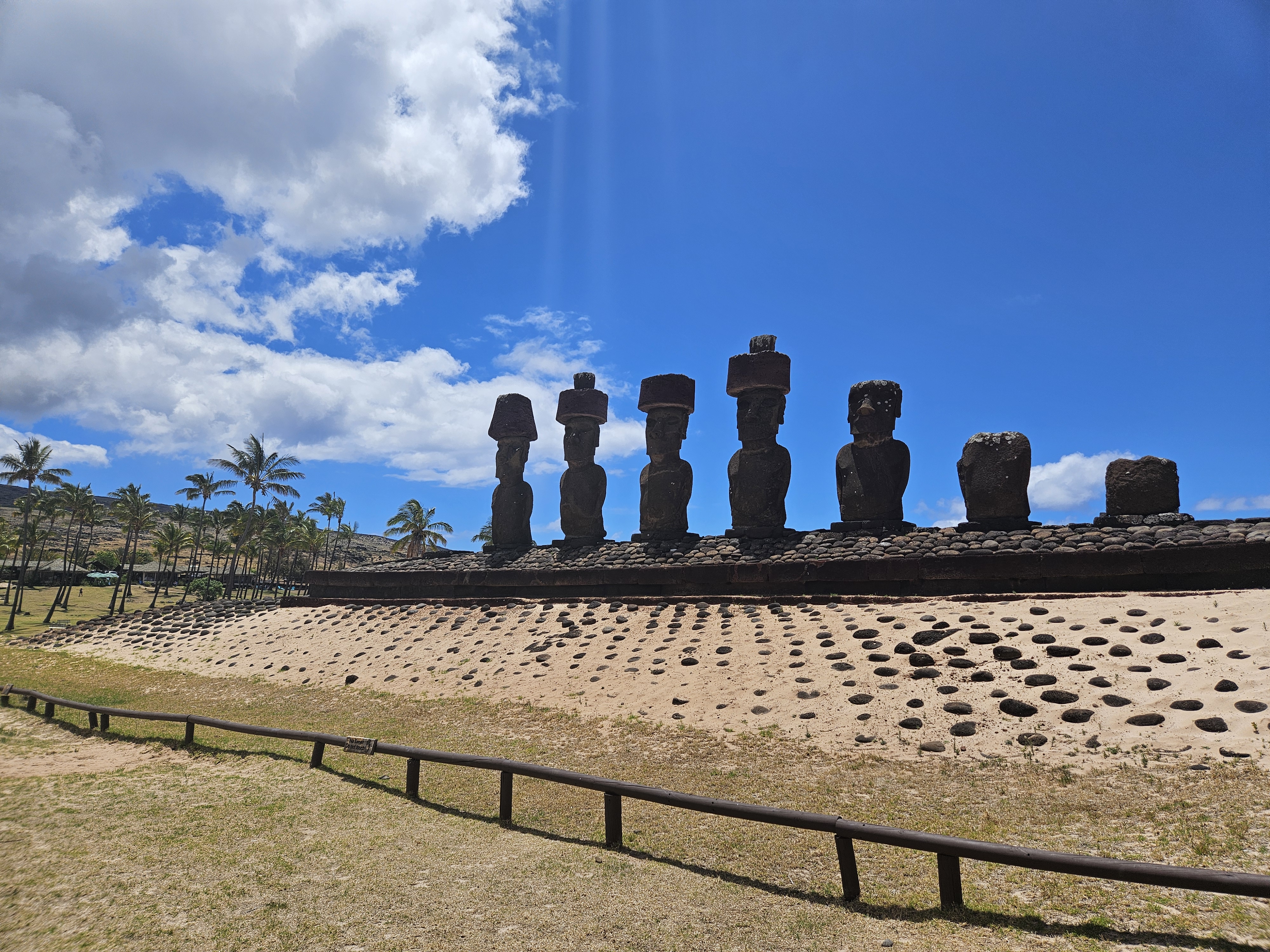


Last up is Anakena- the best preserved moai. When they were toppled, they were covered by sand, which helped keep them in tact. You can see the back tattoos that were carved into all of them, but you can only really see them here. It is also in a beautiful location, right on the (only) beach. I wish I had had more time on the beach because the sand was perfect… but alas.
If you’re wondering how much walking was done on our 2 tour days- I’ve got you. Day 1: 17,153 steps. Day 2: 17,134.

The sunset at Tahai again, with one of our stray dog friends. There were big stray dogs everywhere, and they were all pretty friendly. The island takes care of them I suppose (or more likely, the people.)
One of the biggest questions I had, and I think most people have is… how did the moai get there? Well the really fun answer is… no one really knows. They have a bunch of different theories for how the people moved them to their ahu’s (platforms), but none are conclusive. They could have rolled them on logs. They could have “walked” them by moving them back and forth, which could explain why so many are left on the moai highway. I am just putting it out there that they didn’t rule out aliens ;). Easter Island isn’t listed as a wonder of the world, but I think it should be. I am left wondering a lot, and it is ancient and an absolute marvel. (Really, we have Christ the Redeemer in Rio? I love him, but there is no wonder. It’s well documented how he got up there.) Easter Island definitely gets my vote if there is a re-do.


A quick note about the food. It was the best and most affordable seafood I’ve ever had in my life. The cheapest protein option was freshly caught tuna steaks. Right from the ocean. I ate seafood for every meal, because duh. I’m ruined for tuna now because it was literally so delicious.
I did a snorkel tour on my last day. The snorkeling itself was pretty lame, but the boat ride was awesome. We snorkeled at the bird man islands. Seeing them up close and from the water makes me in awe of the birdman games even more. I also didn’t bring my phone because… snorkeling. It was also cold and the shop didn’t have any wetsuits that would fit me. They didn’t try very hard TBH, and I was annoyed because it’s not like I’m that differently sized than a man, but I tried my best to be best.
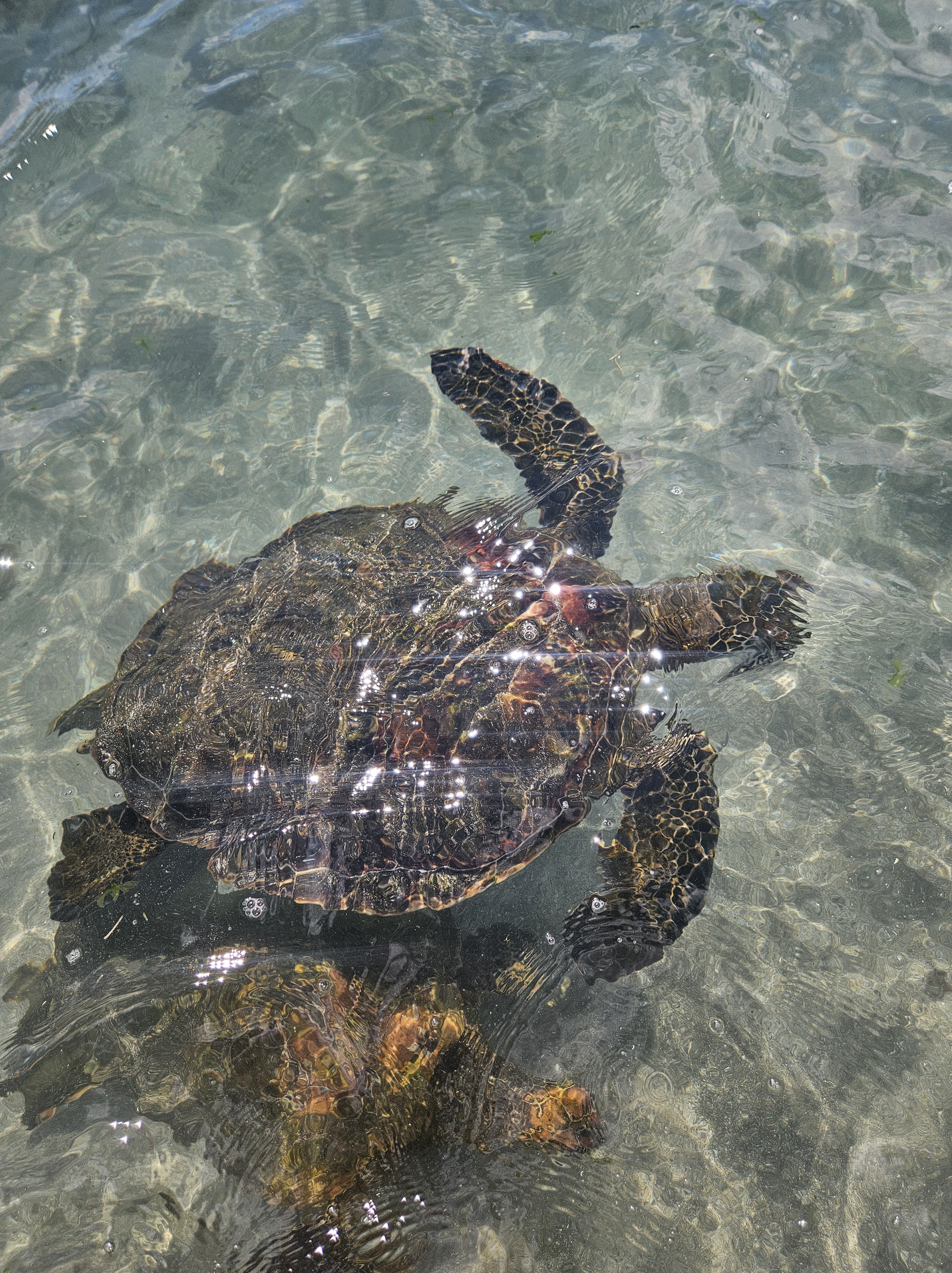


So learning about the moai and seeing them in person was a dream come true. Buttttttttt, swimming with sea turtles just like right there and having their little fins touch my shins was something I could never have dreamed to ask for. I counted 8 at one point. You can just stand there in like hip deep water and hang out with sea turtles. Now they are my best friends. I. Loved. It.

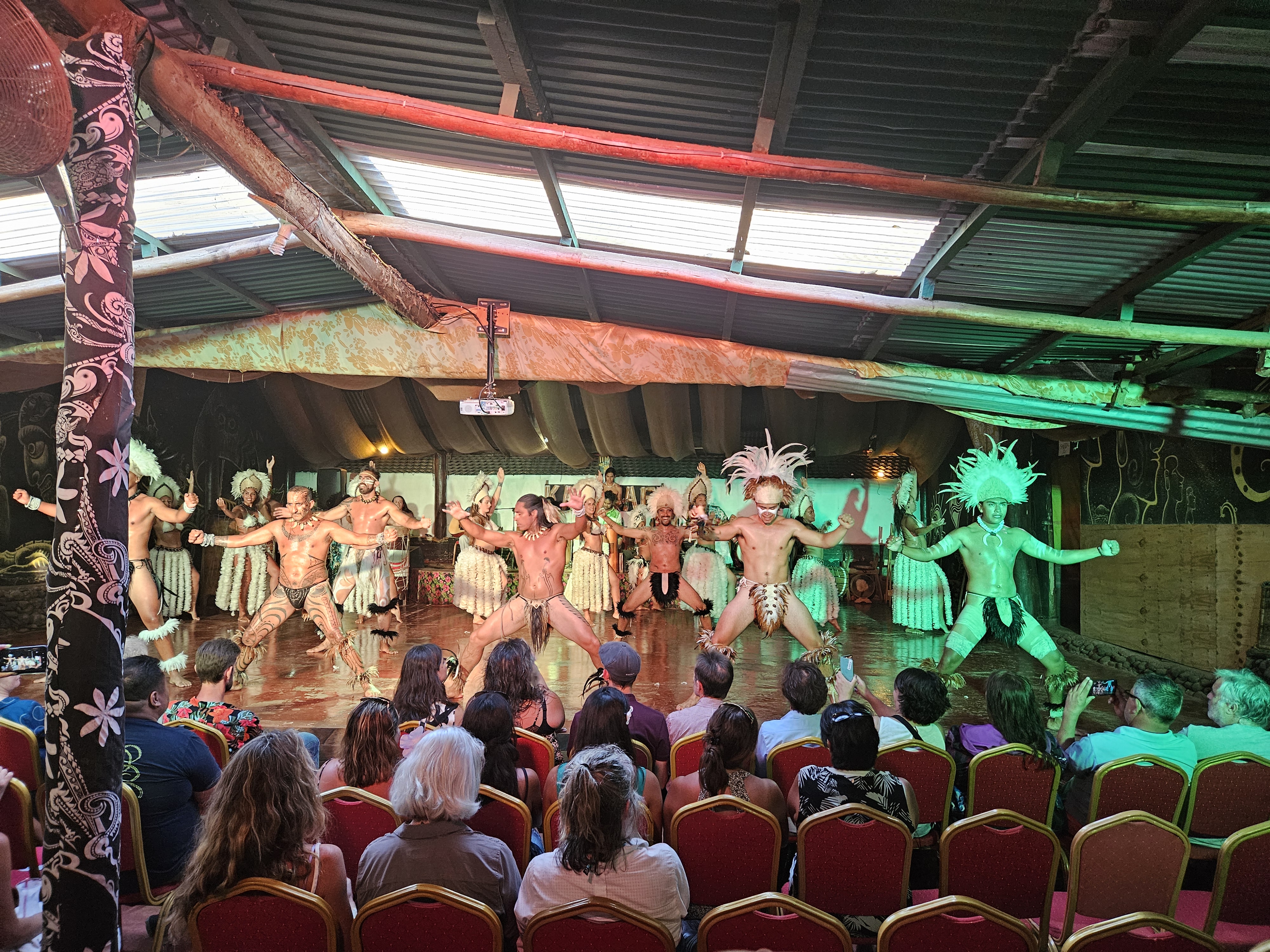


On our last night we went to the Kari Kari Cultural Ballet where some pretty incredible dancers entertained us and shared their cultural dances with us. Before the show started, one of the dancers face painted anyone who wanted it.
Not gonna lie, I didn’t realize how sexy these dances were. You can see a short snippet here. But this clip doesn’t show the men, and they were really feeling themselves the night we were there. There was more audience participation than I am a fan of- I did not want to dance. I wanted to see them do it, but it was still a really fun evening.

The grand finale was watching the sunrise at Tongariki. This is a special tour, and we didn’t have the best sky for it, but I still think it was worth doing.
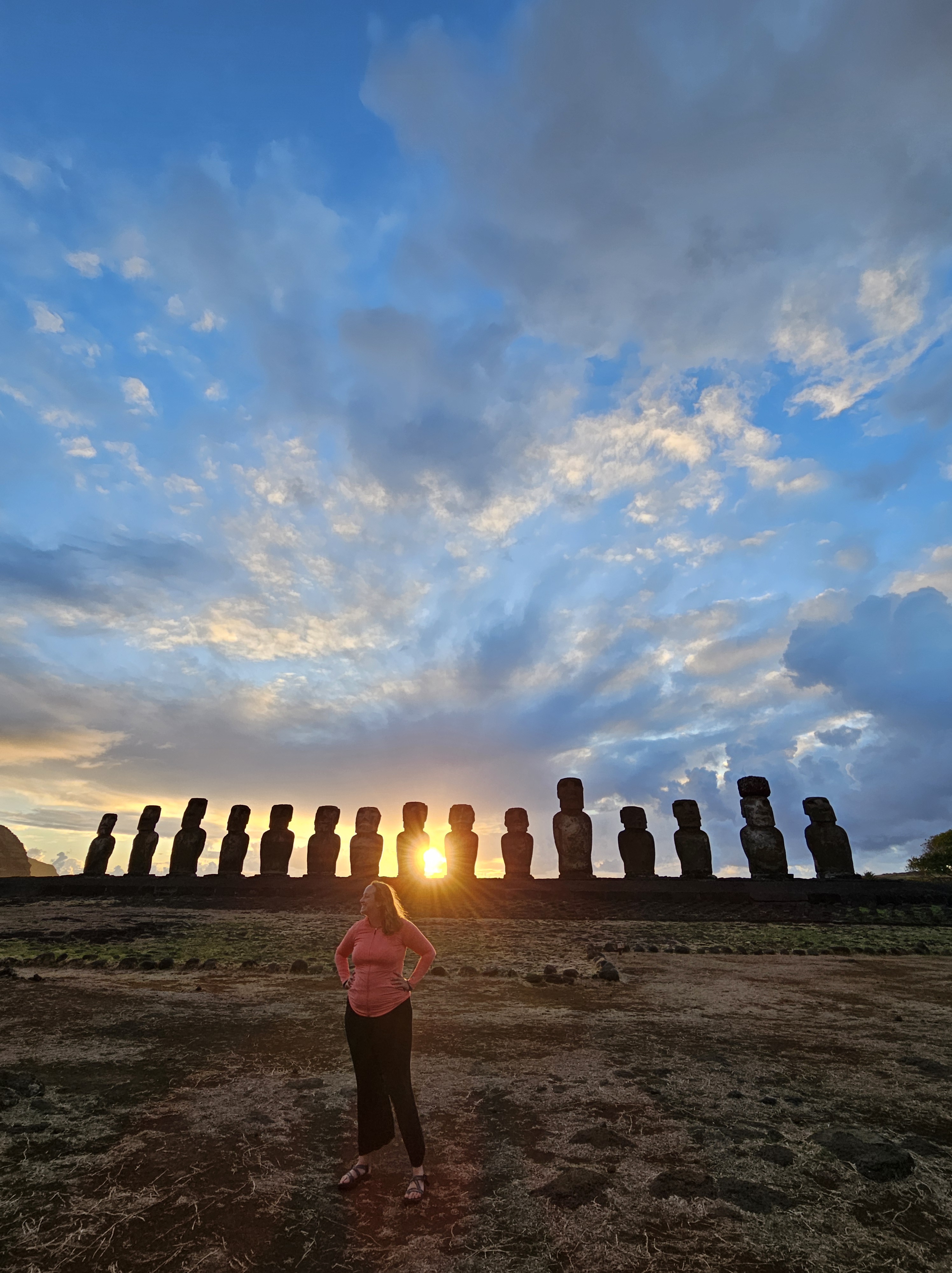
This is possibly my favorite picture of the trip, which is a bold statement.
Before our flight we walked to the museum and got to read about stuff that we pretty much learned already on our tours, ha! But seeing some of the original tools was neat.
A quick note to talk about expenses. I didn’t find Easter Island to be all that expensive. Yes, the flight to get there cost about $450. Maria and I split an accommodation (which I can’t remember how much it cost) that was on par for any regular hotel in South America, which means, less than the US. 2 days of tours cost about $90, the park ticket that you have to buy separately costs $80, the cultural ballet cost $30, snorkeling was $25, the sunrise tour was $30 ish. We ate breakfast at our little cabin, which we bought at the store. Lunch and dinner cost between $15-$20 a meal, depending on what kind of drinks you ordered. You don’t pay for any transportation while there because you can walk the entire town, and the tours include transport. On the whole, it is not nearly as expensive as I was prepared for when thinking of going to Easter Island. If you plan a trip to Italy, I can guarantee you’ll be spending much much more.
Bonus treat- every time the guide would introduce a new place, the song from How the Grinch Stole Christmas would pop into my head. At the end, when the Whos are singing around the tree… “Ahu dory, fa who dory… blah blah blah”. You can easily add the sites of Easter Island and replace the lyrics. Sing it with me- Ahu Akivi, Huri A Urenga, Akahanga, Tonagriki…. Once I placed it, I couldn’t ever not hear it, haha! You’re welcome.
Easter Island was magical, the people were so friendly, the food was delicious, and the weather was perfect. Maria and I traveled really well together and had a blast. I couldn’t have asked for a better trip.

 seekingmygreaterperhaps
Leave a reply to Antigua & Tikal- Guatemala – seekingmygreaterperhaps Cancel reply